Brokerage calculator: every charge and your real net P&L
Free brokerage and trading charges calculator for Indian markets. See brokerage, STT, exchange fees, SEBI fee, stamp duty, DP charges and GST for delivery, intraday, futures, options and MCX trades, using 2026 rates. The same calculator also estimates charges for US, UK, European and Asia-Pacific shares, crypto and forex, with every rule dated and broker commission editable.

Advanced charts with a trade planner built in
Trading crypto, forex or US stocks too? Chart them with indicators and drawing tools, then drag entry, stop and target to see the size, the costs and the win rate you need.
- Live crypto, forex and US stock, ETF, gold and oil token charts with SuperTrend, RSI, MACD and a read-only order book
- Funding, open interest and the BTC and ETH options chain in the derivatives terminal
- World indices, an S&P 500 heatmap and a dated AI sell-off explainer
- A world brokerage and charges calculator for 15 countries, crypto and forex
- Net reward-to-risk after fees, slippage and funding, a Risk Lab and a private journal
- New to charts? A pencil-drawn step-by-step chart reading guide
What the brokerage calculator does
Enter a buy price, a sell price and a quantity, pick the segment and your broker, and the calculator lists every charge that appears on an Indian contract note: brokerage, securities transaction tax (STT), exchange transaction charges, the SEBI turnover fee, stamp duty, DP charges on delivery sales and 18% GST. It then shows your net profit or loss, the price move you need just to break even, and what the same trade would cost in the other segments. Results update as you type.
The calculator covers equity delivery, intraday, equity futures and options on NSE and BSE, and MCX commodity futures and options. Broker presets cover the published plans of Zerodha, Groww, Upstox and Angel One; if your broker charges a flat ₹20 per order, use the flat ₹20 option.
- Brokerage on the buy. What your broker charges for the order.
- Stamp duty or buy-side tax. In India, stamp duty is paid on the buy. The UK, Hong Kong and others have their own versions.
- Exchange and regulator fees. Small fees per trade to the exchange and the regulator.
- GST on fees. In India, 18% GST on brokerage and exchange fees (not on STT or stamp duty).
- Brokerage on the sell. Charged again on the way out.
- STT or sell-side fees. In India, Securities Transaction Tax; in the US, the SEC fee and FINRA TAF on sells.
- Exchange fees on the sell. Charged on the second order as well.
- GST on the sell. Again on the fees of the second order.
On the real screen: The home page calculator shows each of these lines for your country, and the screenshot further down shows a UK example.
New-user habitCompare net profit after all charges, not the gross move.
Common mistakeAssume “zero brokerage” means zero cost. Taxes and exchange fees still apply.
Showing India. Pick another market in the calculator to see its charges and a worked example here.
Charges on every Indian trade (rates as of October 2026)
| Charge | Delivery | Intraday | Futures | Options | Who gets it |
|---|---|---|---|---|---|
| Brokerage (Zerodha) | ₹0 | 0.03% or ₹20 | 0.03% or ₹20 | ₹20 flat | Your broker, per executed order |
| STT | 0.1% buy & sell | 0.025% sell | 0.05% sell | 0.15% of premium, sell | Government of India |
| NSE transaction charge | 0.00307% | 0.00307% | 0.00183% | 0.03553% of premium | Exchange (includes IPFT) |
| SEBI turnover fee | ₹10 per crore of turnover | SEBI | |||
| Stamp duty | 0.015% buy | 0.003% buy | 0.002% buy | 0.003% buy | State governments |
| GST | 18% on brokerage + exchange charges + SEBI fee | Government of India | |||
| DP charge | Per scrip on sell | — | — | — | Depository + broker |
Two rate changes in 2026 matter. NSE revised its transaction charges from 1 March 2026 (equity 0.00307%, futures 0.00183%, options 0.03553% of premium, with the investor protection fund charge now included). The Finance Act 2026 raised STT on derivatives from 1 April 2026: futures went from 0.02% to 0.05% of the sell value and options from 0.1% to 0.15% of the premium sold. The calculator uses these new rates.
Worked example: equity delivery
You buy 100 shares at ₹500 and sell them later at ₹520 through Zerodha. Gross profit is ₹2,000. The charges are:
| Brokerage | ₹0.00 |
| STT (0.1% of ₹1,02,000) | ₹102.00 |
| Exchange charges (0.00307%) | ₹3.13 |
| SEBI fee | ₹0.10 |
| Stamp duty (0.015% of ₹50,000) | ₹7.50 |
| DP charge (incl. GST) | ₹15.34 |
| GST on fees | ₹0.58 |
| Total charges | ₹128.66 |
| Net profit | ₹1,871.34 |
STT is the largest cost on a delivery trade, not brokerage. With Groww, Upstox or Angel One the same trade costs about ₹184 because they charge brokerage on delivery and a DP fee of ₹20 + GST.
Worked example: intraday
Buying 100 shares at ₹1,000 and selling at ₹1,010 on the same day gives a gross profit of ₹1,000. Brokerage is ₹20 per order (₹40), STT is ₹25.25 on the sell side, exchange charges ₹6.17, stamp duty ₹3 and GST ₹8.35. Total charges come to about ₹82.97, so you keep ₹917.03. The price needs to move about 83 paise per share before you make any money at all.
Worked example: F&O
One Nifty futures lot (65 units) bought at 25,000 and sold at 25,100 earns a gross ₹6,500. Because STT on futures is now 0.05% of the sell value, STT alone is ₹815.75 and total charges are about ₹969.61, leaving ₹5,530.39. One Nifty options lot bought at a premium of ₹150 and sold at ₹180 costs only about ₹74 in charges, because STT and exchange fees on options are calculated on the premium, not on the underlying value. The F&O charges guide covers lot-by-lot examples.
MCX commodity charges
Commodity trades pay commodity transaction tax (CTT) instead of STT: 0.01% on the sell side of non-agricultural futures and 0.05% on options premium sold. MCX transaction charges are 0.0021% on futures and 0.0418% on options premium. One crude oil futures lot (100 barrels) bought and sold at ₹6,000 costs about ₹150 in charges. Compare a standard and mini lot with the MCX crude oil brokerage calculator, then download the fee lines to check against your contract note.
How to read the result
- Net P&L is what reaches your account after every charge.
- Breakeven move is total charges divided by quantity: the amount the price must move in your favour before you make money.
- Charges ÷ turnover lets you compare trades of different sizes. Delivery trades usually cost 0.1–0.2% of turnover because of STT; intraday trades cost far less per rupee traded but happen more often.
- Segment comparison shows the same prices in each segment. It is for learning, not a recommendation: delivery, intraday and F&O carry very different risks.
Brokerage calculator for Zerodha, Groww, Upstox and Angel One
Statutory charges (STT, exchange fees, SEBI fee, stamp duty and GST) are the same at every broker. What differs is brokerage and the DP charge. Zerodha charges ₹0 on delivery and ₹15.34 per scrip (including GST) as DP. Groww and Angel One charge ₹20 or 0.1% per order, whichever is lower, with a ₹5 minimum, and ₹20 + GST as DP. Upstox charges ₹20 per delivery order and ₹20 + GST as DP. The full comparison, including account maintenance charges, is in Zerodha vs Groww vs Upstox vs Angel One.
United States: worked example with the calculator’s numbers
A US share trade has almost no statutory cost. The buy is free of tax, and the sale pays two small regulatory fees that brokers pass on. The calculator opens on 50 shares bought at $180.00 and sold at $186.00 with a $0-commission broker.
| Line | How it is worked out | Amount |
|---|---|---|
| Commission, buy and sell | Charles Schwab preset, $0 online | $0.00 |
| SEC Section 31 fee | $9,300 sold × $20.60 per $1 million | $0.19 |
| FINRA trading activity fee | paused 1 Oct – 31 Dec 2026 | $0.00 |
| Total | $0.19 | |
| Net profit | $300.00 gross − $0.19 | $299.81 |
- $9,300 sold. US regulatory fees are charged only on the sale. Buying costs nothing beyond commission.
- $20.60 per million. The SEC Section 31 rate in force from 4 April 2026, passed on by the broker.
- TAF $0.00. FINRA paused its trading activity fee for trades from 1 October to 31 December 2026. From January it adds about a cent on this sale.
- $0.19. Less than a tenth of a percent of the gain. In the US the spread and any FX conversion usually matter far more.
On the real screen: Pick “US & Canada” above and the calculator opens on this trade.
Good habitIf you fund in rupees, check the conversion rate your broker uses; it can cost more than every other line here.
Common mistakeAssuming “commission-free” means the spread is free too.
What changes the answer:
- A per-share broker. Interactive Brokers Pro Fixed charges $0.005 a share with a $1 minimum, so small orders pay $1 each way.
- Currency. Indian investors usually convert rupees to dollars first; a 1% markup on $9,000 is $90, almost 500 times the SEC fee.
- Options and ADRs carry their own fees, which this example leaves out.
Canada: worked example with the calculator’s numbers
On a Canadian-listed share the calculator usually shows nothing at all, because there is no transaction tax and several brokers charge no commission. The opening example is 100 shares bought at C$60.00 and sold at C$62.50.
| Line | How it is worked out | Amount |
|---|---|---|
| Commission, buy and sell | Questrade preset, C$0 online | C$0.00 |
| Transaction tax | none in Canada | C$0.00 |
| Total | C$0.00 | |
| Net profit | C$250.00 gross | C$250.00 |
- C$0 commission. Several Canadian brokers charge nothing for online stock and ETF trades.
- No transaction tax. Canada has no stamp duty or transaction tax on shares.
- C$250.00. The whole gross gain reaches the account.
- About C$184. The real cost appears when you buy a US-listed share from a Canadian-dollar account. The rate here is an example.
On the real screen: Switch to Canada under “US & Canada” to see this trade.
Good habitHold US-dollar cash in a US-dollar account if you buy US shares often.
Common mistakeComparing Canadian brokers on commission and ignoring the conversion spread.
What changes the answer:
- Buying a US-listed share in a Canadian-dollar account. Put the conversion fee in the calculator’s FX field.
- A broker without a verified preset, such as TD Direct Investing: type the commission from its current price list.
- Tax on the gain, which is a tax on the result, not a trading charge.
United Kingdom: worked example with the calculator’s numbers
Most UK share purchases pay stamp duty reserve tax, so a UK round trip always costs more than the dealing fees suggest. The calculator opens on 2,000 shares bought at £4.20 and sold at £4.45 with a £6.95 dealing fee.
| Line | How it is worked out | Amount |
|---|---|---|
| Dealing fee, buy and sell | Hargreaves Lansdown, £6.95 a deal | £13.90 |
| Stamp duty reserve tax | 0.5% of £8,400 bought | £42.00 |
| PTM levy | only on orders above £10,000 | £0.00 |
| Total | £55.90 | |
| Net profit | £500.00 gross − £55.90 | £444.10 |
- SDRT, £42. 0.5% of the £8,400 purchase. Charged on the buy only, and the biggest line by far.
- Dealing, £13.90. Hargreaves Lansdown’s £6.95 online deal fee on each side.
- Break-even 2.8p. £55.90 spread over 2,000 shares.
- Net £444.10. Over a tenth of a small gain goes in charges, mostly tax.
On the real screen: Pick UK above; switch the product to ETFs and the SDRT line disappears.
Good habitUse the ETF or AIM exemption where it fits your plan, and check whether you pay the frequent-trader rate.
Common mistakeComparing UK platforms on dealing fees while the stamp duty is three times larger.
What changes the answer:
- An order above £10,000 adds the £1.50 PTM levy on that order.
- ETFs and AIM shares are exempt from SDRT, so the same trade costs £13.90.
- Buying US shares from a UK account adds the platform’s FX fee, often a percentage of the trade.
France: worked example with the calculator’s numbers
France taxes purchases of shares in French companies valued above €1 billion. The calculator opens on 40 shares bought at €120.00 and sold at €126.00 with a €1-per-order broker.
| Line | How it is worked out | Amount |
|---|---|---|
| Order fees, buy and sell | Trade Republic preset, €1 each | €2.00 |
| French financial transaction tax | 0.4% of €4,800 bought | €19.20 |
| Total | €21.20 | |
| Net profit | €240.00 gross − €21.20 | €218.80 |
- €4,800. Only the purchase is taxed.
- €19.20. 0.4% French financial transaction tax on large French companies, since April 2025.
- €2.00. An app broker’s €1 per order.
- €218.80. Tax is about 8% of this small gain.
On the real screen: Choose France under Europe above to load this example.
Good habitCheck whether the company is on the taxable list before trading it often.
Common mistakeExpecting a tax on the sale as well; France charges only on net purchases.
What changes the answer:
- Smaller French companies, foreign shares and most ETFs are outside the tax.
- Buying and selling on the same day can net to zero for the tax, depending on how the broker reports it.
- Bank brokers often charge a percentage per order instead of €1.
Germany: worked example with the calculator’s numbers
Germany has no tax on share transactions, so the calculator shows only the broker’s fee. It opens on 30 shares bought at €150.00 and sold at €157.00 with a €1-per-order broker.
| Line | How it is worked out | Amount |
|---|---|---|
| Order fees, buy and sell | Trade Republic preset, €1 each | €2.00 |
| Transaction tax | none in Germany | €0.00 |
| Total | €2.00 | |
| Net profit | €210.00 gross − €2.00 | €208.00 |
- €2.00. Only the broker’s order fee. No stamp duty or transaction tax exists for shares.
- €23.03. A percentage plan with a minimum, as many banks use: 0.25% of €4,500 and of €4,710.
- €208.00 net. At the app broker the gain is almost untouched.
- €186.97 net. The broker choice is the whole cost in Germany.
On the real screen: Choose Germany under Europe and type your own bank’s tariff to compare.
Good habitCheck exchange and third-party fees on the order preview; some venues add a small handling charge.
Common mistakePaying a percentage tariff for small orders out of habit.
What changes the answer:
- A bank or full-service broker charging a percentage with a minimum per order.
- The execution venue: some charge an extra fee or show a wider spread.
- Tax on the gain, settled through the broker, is a tax on the result rather than a trading charge.
Italy: worked example with the calculator’s numbers
Italy taxes on-exchange purchases of shares in Italian companies, and the rate doubled at the start of 2026. The opening example is 200 shares bought at €25.00 and sold at €26.20.
| Line | How it is worked out | Amount |
|---|---|---|
| Order fees, buy and sell | Trade Republic preset, €1 each | €2.00 |
| Italian financial transaction tax | 0.2% of €5,000 bought | €10.00 |
| Total | €12.00 | |
| Net profit | €240.00 gross − €12.00 | €228.00 |
- €5.00. The old on-exchange rate of 0.1%.
- €10.00. The rate doubled to 0.2% from January 2026.
- €2.00. Two €1 orders.
- 5% of the gain. €12 of a €240 gain.
On the real screen: Choose Italy under Europe above.
Good habitCheck whether the company is small enough to be exempt.
Common mistakeUsing a 2025 cost table for a 2026 trade.
What changes the answer:
- Small-cap Italian companies are exempt.
- Off-exchange purchases have historically carried a higher rate than on-exchange ones.
- Intraday positions closed the same day are treated differently; the broker report decides.
Spain: worked example with the calculator’s numbers
Spain taxes purchases of shares in Spanish companies valued above €1 billion. The calculator opens on 150 shares bought at €30.00 and sold at €31.50.
| Line | How it is worked out | Amount |
|---|---|---|
| Order fees, buy and sell | Trade Republic preset, €1 each | €2.00 |
| Spanish financial transaction tax | 0.2% of €4,500 bought | €9.00 |
| Total | €11.00 | |
| Net profit | €225.00 gross − €11.00 | €214.00 |
- €4,500. The purchase value is what is taxed.
- €9.00. 0.2% on large Spanish companies.
- €2.00. Two €1 orders.
- €214.00. About 5% of the gain went in charges.
On the real screen: Choose Spain under Europe above.
Good habitCheck the company’s size against the €1 billion threshold.
Common mistakeAssuming every Spanish share is taxed.
What changes the answer:
- Smaller companies and sales are not taxed.
- Positions opened and closed the same day are generally excluded.
- Foreign shares bought on a Spanish platform follow their home country’s rules.
Netherlands: worked example with the calculator’s numbers
Dutch share trades carry no transaction tax, so only broker fees appear. The opening example is 60 shares bought at €80.00 and sold at €84.00.
| Line | How it is worked out | Amount |
|---|---|---|
| Order fees, buy and sell | Trade Republic preset, €1 each | €2.00 |
| Transaction tax | none | €0.00 |
| Total | €2.00 | |
| Net profit | €240.00 gross − €2.00 | €238.00 |
- €240. Sixty shares up €4 each.
- €2. The only charge in this example.
- No tax. Dutch shares carry no transaction tax.
- €238. Almost the whole gain.
On the real screen: Choose the Netherlands under Europe above.
Good habitWatch the FX fee when buying outside the euro area.
Common mistakeIgnoring custody or connectivity fees some brokers charge yearly.
What changes the answer:
- Exchange or handling fees that some brokers add per order.
- Currency conversion on non-euro shares.
- Yearly account fees, which do not show in a single trade.
Ireland: worked example with the calculator’s numbers
Buying shares in an Irish company costs 1% stamp duty, the highest rate the calculator covers. The opening example is 100 shares bought at €40.00 and sold at €42.00.
| Line | How it is worked out | Amount |
|---|---|---|
| Order fees, buy and sell | Trade Republic preset, €1 each | €2.00 |
| Irish stamp duty | 1% of €4,000 bought | €40.00 |
| Total | €42.00 | |
| Net profit | €200.00 gross − €42.00 | €158.00 |
- €40. 1% of the purchase, the highest share tax in the calculator.
- €2. Order fees are trivial next to it.
- 1.05%. The share must rise this much before the trade makes money.
- 21%. A fifth of the gain gone on a 5% move.
On the real screen: Choose Ireland under Europe above.
Good habitHold Irish shares for bigger moves, or use exempt ETFs for exposure.
Common mistakeTrading Irish shares for small swings.
What changes the answer:
- Irish-domiciled ETFs are exempt, which is one reason so many European ETFs are based there.
- Irish companies listed abroad may be settled through a different system with its own rules.
- The tax is on the buy, so a quick round trip carries the full 1%.
Belgium: worked example with the calculator’s numbers
Belgium’s tax on stock exchange transactions (TOB) is charged on purchases and on sales. The calculator opens on 80 shares bought at €60.00 and sold at €63.00.
| Line | How it is worked out | Amount |
|---|---|---|
| Order fees, buy and sell | Trade Republic preset, €1 each | €2.00 |
| TOB on the purchase | 0.35% of €4,800 | €16.80 |
| TOB on the sale | 0.35% of €5,040 | €17.64 |
| Total | €36.44 | |
| Net profit | €240.00 gross − €36.44 | €203.56 |
- €16.80. 0.35% when you buy.
- €17.64. And again when you sell, on the higher sale value.
- €2. Order fees.
- €203.56. A sell-side tax means a winning trade pays more tax than a losing one.
On the real screen: Choose Belgium under Europe above.
Good habitCheck the ETF rate if you use funds; it differs from shares.
Common mistakeForgetting the second TOB when planning a target.
What changes the answer:
- ETFs pay their own TOB rates, which depend on how the fund is structured.
- A foreign broker may leave you to declare and pay the TOB yourself.
- The €1,600 cap per transaction only helps on orders above about €457,000.
Switzerland: worked example with the calculator’s numbers
Switzerland charges a transfer stamp duty when a Swiss securities dealer is involved, on both the purchase and the sale. The opening example is 50 Swiss shares bought at CHF 90.00 and sold at CHF 94.00. No broker preset is filled in, so commission starts at zero.
| Line | How it is worked out | Amount |
|---|---|---|
| Commission | type your broker’s figure | CHF 0.00 |
| Swiss transfer stamp duty | 0.075% of CHF 4,500 and of CHF 4,700 | CHF 6.90 |
| Total before commission | CHF 6.90 | |
| Net profit | CHF 200.00 gross − CHF 6.90 | CHF 193.10 |
- CHF 3.38. 0.075% on Swiss securities, on the buy.
- CHF 3.53. The same rate on the sale.
- Commission. Swiss brokers price very differently, so the calculator leaves it for you to type.
- CHF 6.90. A foreign share would pay twice the rate.
On the real screen: Choose Switzerland under Europe and type your broker’s commission.
Good habitAsk whether your broker is a Swiss securities dealer; the duty depends on it.
Common mistakeLeaving the commission at zero when your broker charges one.
What changes the answer:
- Foreign securities pay 0.15% per side through a Swiss dealer.
- Exchange and clearing fees, which some Swiss banks show separately.
- A non-Swiss broker may not charge the stamp duty at all.
Hong Kong: worked example with the calculator’s numbers
A Hong Kong share trade pays stamp duty on both sides plus several small levies and exchange fees. The calculator opens on 1,000 shares bought at HK$80.00 and sold at HK$84.00 with a HK$15-per-order platform fee.
| Line | How it is worked out | Amount |
|---|---|---|
| Platform fee, buy and sell | Futu (moomoo) preset, HK$15 each | HK$30.00 |
| Stamp duty | 0.1% each side, rounded up | HK$164.00 |
| SFC transaction levy | 0.0027% each side | HK$4.43 |
| AFRC transaction levy | 0.00015% each side | HK$0.25 |
| HKEX trading fee | 0.00565% each side | HK$9.27 |
| CCASS settlement fee | 0.0042% each side | HK$6.89 |
| Total | HK$214.83 | |
| Net profit | HK$4,000.00 gross − HK$214.83 | HK$3,785.17 |
- HK$80 on the buy. 0.1% of the purchase, rounded up to the next whole dollar.
- HK$84 on the sale. Hong Kong charges stamp duty on both sides, unlike the UK.
- HK$50.83. Two HK$15 platform fees plus the SFC and AFRC levies, the HKEX fee and settlement.
- 0.27%. The share must rise this much before the trade makes a dollar.
On the real screen: Choose Hong Kong under Asia-Pacific above to load this trade.
Good habitSet targets well above 0.3% on Hong Kong shares.
Common mistakeCounting stamp duty only once.
What changes the answer:
- Some brokers replace the CCASS fee with their own settlement scale.
- Board lots differ by stock, so the smallest order can be large.
- ETFs may be exempt from stamp duty; check the product.
Singapore: worked example with the calculator’s numbers
Singapore share trades carry no stamp duty, but broker, exchange and settlement fees each add up, with 9% GST on top. The opening example is 2,000 shares bought at S$4.50 and sold at S$4.72.
| Line | How it is worked out | Amount |
|---|---|---|
| Commission and platform fee | moomoo SG preset, 0.03% + 0.03% with minimums | S$11.06 |
| SGX clearing fee | 0.0325% of contract value | S$5.99 |
| SGX trading fee | 0.0075% of contract value | S$1.38 |
| Settlement instruction fee | S$0.35 each side | S$0.70 |
| GST | 9% on the fees | S$1.72 |
| Total | S$20.86 | |
| Net profit | S$440.00 gross − S$20.86 | S$419.14 |
- S$11.06. 0.03% commission plus 0.03% platform fee on each side, with minimums.
- S$5.99. The SGX clearing fee, 0.0325% of the value.
- S$1.72. 9% GST on broker and exchange fees.
- S$0.70. A settlement instruction fee for CDP-linked accounts.
On the real screen: Choose Singapore under Asia-Pacific above.
Good habitCompare custodian and CDP accounts; the settlement line differs.
Common mistakeIgnoring GST when comparing Singapore brokers.
What changes the answer:
- Custodian accounts may not charge the settlement instruction fee.
- Minimum fees dominate small orders.
- The clearing fee is capped at S$600, which only matters on very large trades.
Japan: worked example with the calculator’s numbers
Japanese cash shares can be traded with no commission at the large online brokers, and there is no transaction tax. The calculator opens on 100 shares, the usual trading unit, bought at ¥3,000 and sold at ¥3,150.
| Line | How it is worked out | Amount |
|---|---|---|
| Commission, buy and sell | SBI Securities preset, ¥0 online | ¥0 |
| Transaction tax | none | ¥0 |
| Total | ¥0 | |
| Net profit before tax on the gain | ¥15,000 gross | ¥15,000 |
- ¥0. Large online brokers charge no commission on Japanese cash shares.
- ¥15,000. One unit of 100 shares up ¥150.
- ¥3,047. Japan taxes residents’ share gains at 20.315%, including the reconstruction surtax.
- NISA. Inside the tax-free account the whole gain is kept.
On the real screen: Choose Japan under Asia-Pacific above.
Good habitUse the NISA allowance before a taxable account.
Common mistakeReading ¥0 charges as ¥0 cost.
What changes the answer:
- Margin trading adds interest and stock-lending fees.
- Foreign shares bought from Japan carry FX and foreign commission.
- The 20.315% tax applies in a taxable account; NISA gains are exempt.
Australia: worked example with the calculator’s numbers
ASX share trades pay no stamp duty, so the cost is brokerage, which at CommSec follows a tiered scale. The calculator opens on 200 shares bought at A$45.00 and sold at A$47.20.
| Line | How it is worked out | Amount |
|---|---|---|
| Brokerage on the buy | A$9,000, tier up to A$10,000 | A$19.95 |
| Brokerage on the sale | A$9,440, same tier | A$19.95 |
| Total | A$39.90 | |
| Net profit | A$440.00 gross − A$39.90 | A$400.10 |
- A$19.95. The tier that covers the A$9,000 purchase and A$9,440 sale.
- A$29.95. Orders up to A$25,000.
- 0.12%. Above A$25,000 the fee becomes a percentage: A$60 on A$50,000.
- 9% of the gain. A$39.90 on a A$440 gain.
On the real screen: Choose Australia under Asia-Pacific above.
Good habitSize orders with the tier edges in mind; A$10,001 costs the next tier up.
Common mistakeSplitting one order into two and paying two fees.
What changes the answer:
- Low-cost brokers charge a flat A$3 to A$10 an order instead of tiers.
- Settling to an account other than the broker’s cash account can change the tariff.
- International shares add FX fees.
Crypto: worked example with the calculator’s numbers
Crypto trades have no stamp duty or transaction tax, only the exchange fee, the spread or slippage, and on perpetual futures the funding rate. The calculator opens on a spot trade of 0.05 coin bought at $75,000 and sold at $77,500.
| Line | How it is worked out | Amount |
|---|---|---|
| Exchange fees | 0.10% of $3,750 and of $3,875 | $7.63 |
| Spread or slippage | 0.02% each side | $1.53 |
| Total | $9.15 | |
| Net | $125.00 gross − $9.15 | $115.85 |
- $3,750. Crypto is calculated in dollars on this tab.
- $7.63. Binance regular-tier spot fee, 0.10% per side.
- $1.53. Slippage you assume; market orders rarely fill at the screen price.
- $115.85. In India, tax and 1% TDS apply to the result and are not included.
On the real screen: Pick Crypto above; switch to Perpetual and add a funding rate.
Good habitUse limit orders where possible and check the fee tier you are on.
Common mistakeComparing exchanges on maker fees while trading only with market orders.
What changes the answer:
- Perpetual futures: lower trading fees, but funding while the position is open. See the funding rate calculator.
- Instant-buy screens hide a spread of 0.5% to 2% in the price.
- In India, 30% tax on gains and 1% TDS on many sales come on top.
Forex: worked example with the calculator’s numbers
A forex trade has three costs: the spread, any commission per lot, and swap for each night the position is open. The calculator opens on 0.5 lot that gains 30 pips on a raw-spread account, held for two nights.
| Line | How it is worked out | Amount |
|---|---|---|
| Spread | 1 pip × $10 × 0.5 lot | $5.00 |
| Commission | $3.50 per lot per side × 0.5 × 2 | $3.50 |
| Swap | −$0.80 per lot × 0.5 × 2 nights | $0.80 |
| Total | $9.30 | |
| Net | $150.00 gross − $9.30 | $140.70 |
- Spread, $5. One pip on half a lot.
- Commission, $3.50. $3.50 per lot per side, on 0.5 lot, twice.
- Swap, $0.80. Two nights at −$0.80 per lot.
- 6.2%. A small share here; it grows quickly for short targets.
On the real screen: Pick Forex above to load this trade.
Good habitCheck the swap for your side before holding over several nights.
Common mistakeReading $3.50 as the round-trip commission.
What changes the answer:
- Commission quoted per million or in basis points: the FX commission calculator converts it.
- Yen and other non-dollar pairs have a different pip value in dollars.
- Indian residents may trade only permitted pairs on recognised Indian exchanges.
Compare: what the ranking means
The Compare tab prices the same buy and sell in every market using only taxes and exchange levies, so countries can be ranked on equal terms. Commission and currency conversion are left out because they depend on your broker.
- Ireland, 1%. Stamp duty on the purchase.
- UK, 0.5%. SDRT on most share purchases.
- India delivery, 0.222%. STT on both sides plus exchange fees, stamp duty and GST.
- US, 0.002%. Only the SEC fee on the sale.
On the real screen: Pick Compare above for every market and both Indian segments.
Good habitAdd your broker’s commission and FX fee before deciding where to trade.
Common mistakeTreating the lowest tax as the cheapest market overall.
Two things stand out. Purchase taxes in Ireland, the UK and France make short-term trading there expensive, while Germany, the Netherlands, Canada, Japan and Australia charge no transaction tax at all. India’s delivery cost sits in the middle, mostly because STT is charged on both the buy and the sale; India’s intraday cost is much lower per rupee traded.
Limits of any brokerage calculator
The calculator assumes one buy order and one sell order. If your order fills in several parts, each part can attract brokerage. It does not include account maintenance charges, call-and-trade fees, pledge fees, payment gateway fees or interest on margin trading. BSE transaction charges differ by scrip group, and option exercise and assignment are charged differently from a normal sale. Treat the result as a close estimate and check your contract note, which is the final record. On a fast day, extra slippage or a gap through your stop can cost more than the brokerage printed here; these charges do not include that.
Trading charges in other countries
The calculator above covers 15 countries, crypto and forex as well as India. Pick a market with the switch at the top of the calculator: the worked example above changes to that market, and each country’s rules are explained in the notes below. Taxes and exchange levies fill in by themselves. You type your own broker’s commission, because broker prices change often and differ by account.
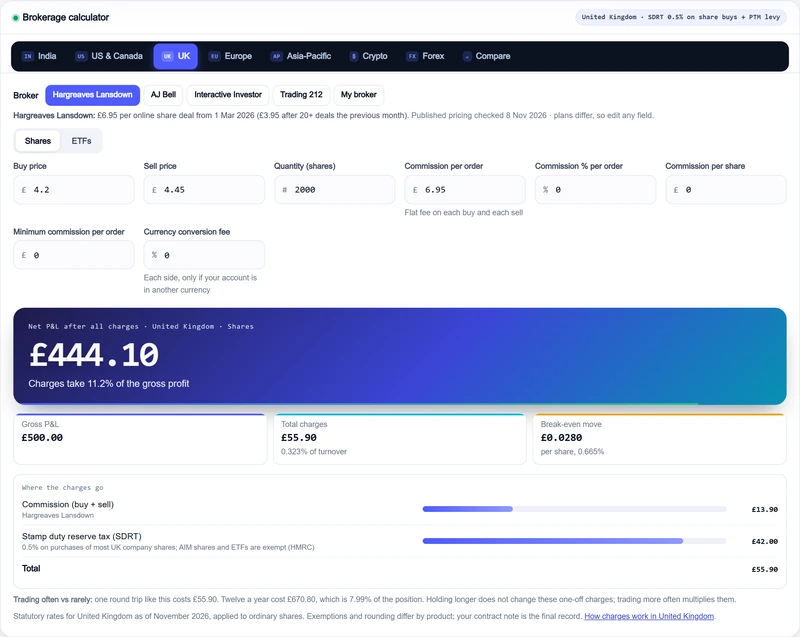
- Status label: which market and which rules are in use.
- Market switch: India, the US, the UK, Europe, Asia-Pacific, crypto or forex.
- Broker chips: presets checked against each broker’s published pricing.
- Broker note: what the preset assumes.
- Product: shares or ETFs.
- Price and quantity: buy price, sell price and how many.
- Commission: per order, editable.
- FX fee: for trades in another currency.
- Net profit: after every charge, £444.10 here.
- Gross, total charges and break-even: £55.90 of charges here.
- Where the charges go: each tax and fee on its own line.
Most of the difference between countries comes from one charge: a tax on buying shares. India charges STT on both sides of a delivery trade. The UK, France, Italy, Spain and Ireland tax only the purchase. The United States has no tax on buying, only small regulatory fees on sales. That is why a short-term round trip costs more in London or Dublin than in New York, even when the brokerage is zero.
| Market | Statutory charges on ordinary shares (November 2026) | Round trip, % of one side |
|---|---|---|
| India (NSE delivery) | STT 0.1% on buy and sell, stamp duty 0.015% on buy, exchange and SEBI fees, 18% GST on brokerage and fees | about 0.22% |
| United States | SEC fee $20.60 per $1 million on sales; FINRA TAF normally $0.000195 a share on sales (max $9.79), paused for trades from 1 October to 31 December 2026. No tax on buys | about 0.002% |
| United Kingdom | Stamp duty (SDRT) 0.5% on buys of most UK shares; £1.50 PTM levy on trades over £10,000 | 0.5% |
| France | Financial transaction tax 0.4% on buys of French companies worth over €1 billion | 0.4% |
| Italy | Financial transaction tax 0.2% on on-exchange buys (doubled from January 2026) | 0.2% |
| Spain | Financial transaction tax 0.2% on buys of large Spanish companies | 0.2% |
| Ireland | Stamp duty 1% on buys of Irish shares | 1% |
| Belgium | TOB 0.35% on each buy and each sell, capped at €1,600 per trade | 0.7% |
| Switzerland | Stamp duty 0.075% per side on Swiss securities (0.15% for foreign ones) | 0.15% |
| Hong Kong | Stamp duty 0.1% each side plus SFC, AFRC, HKEX and settlement fees | about 0.23% |
| Singapore | SGX clearing 0.0325% and access fee 0.0075% each side, 9% GST on fees | about 0.09% |
| Germany, Netherlands, Japan, Canada, Australia | No transaction tax on ordinary share trades; Australia adds 10% GST to brokerage | 0% (commission only) |
How to use these numbers. Add the last column to your broker’s commission on both orders. The total is the move you need before a trade breaks even. For a 0.5% UK stamp duty, a £5 commission each way and a £2,000 position, you need a 1% rise just to get back to zero. Holding for years spreads that cost thin. Trading every week does not.
Rules have exemptions. UK AIM shares, ETFs in most countries, small-cap Italian shares and French or Spanish companies below €1 billion pay no transaction tax. Currency conversion is often the largest hidden cost when you buy foreign shares from an Indian account: 0.25% to 1.5% each way is common, so the calculator has a field for it. Your contract note is the final record.
For crypto, the main costs are the exchange fee, the spread and, for perpetual futures, funding. For forex they are spread, commission per lot and overnight swap. Both have their own tabs, and the trading cost desk compares the yearly cost of a trading style across markets.
How trading charges work, country by country
The calculator applies each country’s published rules automatically. The notes below explain them in plain words, with the date each rate applies from. Rates were checked in November 2026. Tap a country name to open it in the calculator.
United States
There is no tax on buying US shares. On every sale, the SEC Section 31 fee applies at $20.60 per $1 million sold (rate from 4 April 2026), and FINRA’s trading activity fee normally adds $0.000195 a share sold, capped at $9.79 a trade. FINRA paused that fee for trades from 1 October to 31 December 2026, so brokers that pass it through charge nothing for it until 1 January 2027. Most large US brokers charge no commission on online stock and ETF trades; Interactive Brokers’ Pro Fixed plan charges $0.005 a share with a $1 minimum. For a $10,000 sale the SEC fee is about 21 cents.
Canada
Canada has no transaction tax on share trades. Costs come from commission, which several large brokers have cut to zero for online stock and ETF trades, and from currency conversion when you buy US shares in a Canadian-dollar account. Conversion is often the biggest cost: a 1.5% fee each way turns into about 3% on a round trip, so check it before comparing commissions.
United Kingdom
Buying most UK shares costs 0.5% stamp duty reserve tax on the purchase, collected automatically. Shares on AIM and exchange-traded funds are exempt. Trades in UK shares above £10,000 also pay the £1.50 PTM levy. Selling carries no stamp duty. Online dealing fees range from £0 at commission-free apps to £5–£6.95 a deal at large platforms. On a £2,000 purchase the duty is £10, so a quick round trip needs a 0.5% rise before commission.
France
France charges a financial transaction tax of 0.4% on purchases of shares in French companies with a market value above €1 billion, rate in force since April 2025. Smaller companies and sales are not taxed. The tax is levied on net purchases settled during the day, which is why intraday round trips usually escape it.
Germany
Germany has no stock transaction tax. You pay your broker’s commission, which ranges from about €1 per order at app brokers to percentage-based fees at banks, and the bid-ask spread. Capital gains tax applies to profits but is a tax on the result, not a trading charge.
Italy
Italy taxes purchases of shares in Italian companies. From January 2026 the rate for on-exchange purchases doubled from 0.1% to 0.2%. Companies with a small market value are exempt, as are most ETFs. As in France, the tax applies to the net balance bought during the day.
Spain
Spain charges 0.2% on purchases of shares in Spanish companies whose market value exceeds €1 billion. Sales and smaller companies are exempt. Intraday trades that close the same day are generally outside its scope.
Netherlands
There is no transaction tax on Dutch shares. Costs are commission, exchange or handling fees set by your broker, and currency conversion if you buy shares priced in another currency.
Ireland
Buying shares in Irish companies costs 1% stamp duty, the highest rate in this calculator. Irish-domiciled ETFs are exempt. On a €5,000 purchase that is €50 before commission, so frequent trading in Irish shares is expensive.
Belgium
Belgium’s tax on stock exchange transactions (TOB) applies to both purchases and sales: 0.35% for shares, capped at €1,600 per transaction. ETFs have their own rates depending on how they are registered and whether they distribute income. A round trip in shares therefore costs about 0.7% in tax.
Switzerland
The Swiss securities transfer stamp duty applies when a Swiss securities dealer is involved: 0.075% per side for Swiss securities and 0.15% for foreign ones, each paid by both buyer and seller. Foreign brokers outside Switzerland usually do not charge it.
Hong Kong
Hong Kong charges stamp duty of 0.1% on each side of a share trade, rounded up to the next dollar. On top come the SFC levy (0.0027%), the AFRC levy (0.00015%), the HKEX trading fee (0.00565%) and a settlement fee. Many app brokers charge no commission but add a fixed platform fee, often HK$15 an order.
Singapore
Singapore has no stamp duty on shares bought on SGX. Every trade pays a clearing fee of 0.0325% (capped at S$600) and a trading fee of 0.0075%; CDP-linked accounts also pay a S$0.35 settlement instruction fee. GST of 9% is added to brokerage and these fees. Minimum commissions at many brokers make very small trades expensive.
Japan
Japan has no transaction tax on shares. The largest online brokers, including SBI Securities and Rakuten Securities, have charged no commission on online Japanese share trades since 2023. Costs are mainly the spread and, for foreign investors, currency conversion.
Australia
There is no stamp duty on ASX-listed shares. Brokerage is usually quoted including 10% GST and is often tiered by trade value: one large broker charges A$5 up to A$1,000 and A$10 up to A$3,000 online, while app brokers charge a flat A$3 for most trades. For US shares, a currency conversion fee of around 0.5% each way is common.
India’s full rules (STT, exchange charges, SEBI fee, stamp duty, DP charges and GST) are in the sections above. Crypto exchange fees and forex spreads are not taxes; they are set by each platform and are editable in their tabs.
More cost tools
- Zerodha MCX crude oil brokerage calculatorBrokerage, CTT, exchange fees, stamp duty and GST on MCX crude oil.
- True cost of trading calculatorCommission, tax, spread and funding for a month and a year.
- Broker cost matcherThree fee schedules sorted by the cost of your trading.
- Account-opening checklist by countryDocuments brokers usually ask for, by country.
- MTF interest calculatorDaily interest on the funded part of a stock position.
How to calculate intraday F&O brokerage
Keep option trading charges in the options segment even if the trade opens and closes on the same day. Use traded option premiums, not the underlying index quote, as the entry and exit prices. For a comparison involving more than one order or lot, see F&O brokerage per order.
Choose Equity futures or Equity options in the calculator even when opening and closing the trade on the same day. Enter futures prices or per-unit option premiums and set the lot quantity. The charge breakdown applies the selected derivatives segment. See a worked Nifty lot · Charges for a cross-exchange share trade
Compare four brokers on the same trade
The calculator above prices a trade at one broker at a time. To see Zerodha, Groww, Upstox and Angel One in one table, with the lowest total marked, open the brokerage comparison calculator. If you came looking for the Finology brokerage calculator, that tool is run by Finology; TradeProfy is independent and answers the same question for these four brokers.
Single charges have their own tools: the STT calculator for the tax on delivery, intraday and F&O trades, the DP charges calculator for the demat debit on delivery sales, and the bracket order calculator for a target and stop priced after charges. Outside India, the share dealing cost calculator covers UK stamp duty and the PTM levy, and the futures profit calculator covers MES, ES, NQ, crude oil and gold.
Brokerage calculator questions readers ask
How is brokerage calculated in India?
Most discount brokers charge per executed order: either a flat ₹20, or a percentage such as 0.03% of the order value capped at ₹20. Brokerage is charged on both the buy and the sell order. Delivery trades are free at some brokers. GST of 18% is added on top.
What charges apply on intraday trading?
Intraday equity trades pay brokerage on both orders, STT of 0.025% on the sell value, exchange transaction charges of 0.00307% (NSE), a SEBI fee of ₹10 per crore, stamp duty of 0.003% on the buy value and 18% GST on brokerage and fees. There is no DP charge. See intraday charges compared with delivery on the same trade.
What is the STT on futures and options in 2026?
From 1 April 2026, STT is 0.05% of the sell value for futures and 0.15% of the premium for options sold. If an option is exercised, STT is 0.15% of the intrinsic value. Before April 2026 the rates were 0.02% and 0.1%.
Does this calculator work for commodity (MCX) trades?
Yes. Choose MCX futures or MCX options. It applies CTT (0.01% on futures, 0.05% on options premium, sell side), MCX transaction charges, the SEBI fee, stamp duty and GST, with brokerage of ₹20 or 0.03% per order.
Why is my contract note slightly different?
Small differences come from order splits, rounding on each line, BSE scrip-group rates, or a broker plan that differs from the preset. If the difference is large, check whether the trade was marked delivery instead of intraday, which changes STT a lot.
Are DP charges included?
Yes, for delivery sales. DP charges are applied once per scrip per day when shares leave your demat. Zerodha charges ₹15.34 including GST; Groww, Upstox and Angel One charge ₹20 plus GST.
Is the calculator free and private?
Yes. There is no login, and the numbers you enter are calculated in your browser and are not sent to TradeProfy.
Is this investment advice?
No. TradeProfy calculates costs and maths. It is not a SEBI-registered investment adviser and does not recommend any security, segment or strategy.
Which country has the highest tax on buying shares?
Among the markets in this calculator, Ireland’s 1% stamp duty on Irish shares is the highest single charge on a purchase. Belgium’s TOB applies on both sides, about 0.7% on a round trip. The UK charges 0.5% on most share purchases.
Do I pay stamp duty when I sell UK shares?
No. UK stamp duty reserve tax of 0.5% applies to purchases of most UK shares. Selling is not taxed, though trades above £10,000 pay the £1.50 PTM levy.
How much is the SEC fee on a US stock sale in 2026?
From 4 April 2026 the SEC Section 31 fee is $20.60 per $1 million of sales, about 21 cents on a $10,000 sale. It applies only to sales.
Is the FINRA trading activity fee charged in November 2026?
FINRA filed to pause its trading activity fee for trades from 1 October to 31 December 2026, with the fee resuming on 1 January 2027. The calculator shows it as paused for trades dated in that window.
How is Hong Kong stamp duty on shares calculated?
It is 0.1% of the trade value on each side, buyer and seller, rounded up to the next whole Hong Kong dollar. The SFC levy, AFRC levy, HKEX trading fee and settlement fee are added separately.
Which countries have no tax on share trading?
Of the markets here, the United States (sales pay only small regulatory fees), Canada, Germany, the Netherlands, Japan and Australia have no transaction tax on ordinary share trades. You still pay commission, spread and any currency conversion.
Can I calculate charges for Delta Exchange India or another crypto platform here?
This calculator covers Indian equity, F&O and MCX charges. For crypto exchanges that charge a percentage maker or taker fee plus GST, use the trading commission calculator in percentage mode.
Does it work for Dhan, Fyers, INDmoney or SBI Securities?
Choose the custom flat ₹20 plan, or enter the broker’s brokerage per order. Statutory charges are the same at every broker, so the rest of the result is exact.
How is a brokerage calculator in India different from one in the US?
Indian trades carry STT, stamp duty, exchange and SEBI fees and GST; US stock trades usually have zero commission and only tiny regulatory fees on sales. The global cost desk covers the US, UK, EU, forex and crypto.
Charges guides
Charges guides for other countries
More calculators

Written and maintained by Mantu Kumar
This page explains brokerage, statutory charges and after-cost results.
Read Mantu’s profile