Investment return reality check
Paste the return a website promises and see what it means per year, how it compares with real markets, and which of the twelve classic scam warning signs it shows. Free, private and built for checking before you deposit.

What this checker does
Some websites dress up a deposit scheme as a trading desk, a crypto-mining pool or an “AI bot”. They show live-looking price tickers, award badges and a company number, then sell “plans”: put in $200 and get 15% in three weeks, or deposit more than $10,000 and get 30% a day. This page turns that promise into numbers you can compare with real markets, and it gives you a checklist of the warning signs regulators list most often.
Type the return exactly as the site states it and say how often it is paid. The calculator converts it to a yearly figure two ways: simple, where each payout is withdrawn, and reinvested, where each payout is added back, as these sites encourage. It also shows how many days it takes to double your money, what your deposit would grow to, and how much real profit the operator would need to earn to pay everyone. Nothing you type leaves your browser.
The maths behind the verdict
If a scheme pays a return r every p days, it pays n = 365 ÷ p times a year.
- Simple yearly return = r × n. One per cent a day is 365% a year before any reinvesting.
- Reinvested yearly return = (1 + r)n − 1. One per cent a day reinvested is about 3,678% a year: 10,000 would become roughly 3.78 lakh in rupees or $378,000 in dollars.
- Days to double = ln 2 ÷ ln(1 + r) × p. At 1% a day that is about 70 days.
The verdict combines the reinvested rate with the warning signs you tick. Three signs weigh more than the rest: a guaranteed return, a regulator that does not list the firm, and a fee to withdraw. Rates up to about 12% a year score low, because savings products and broad share indices have paid in that range over long periods. Rates above 30% a year score high, and anything in the hundreds or thousands of per cent a year scores very high, because no regulated product promises that and no fund has delivered it consistently. Each ticked warning sign adds to the score. The result is a prompt to check, not a legal finding about any particular firm.

Three worked examples
| Promise | Payouts a year | Simple per year | Reinvested per year | Days to double |
|---|---|---|---|---|
| 1% a day | 365 | 365% | ≈ 3,678% | ≈ 70 |
| 15% every 21 days | ≈ 17.4 | ≈ 261% | ≈ 1,035% | ≈ 104 |
| 5% a month “fixed” | 12 | 60% | ≈ 79.6% | ≈ 432 |
| 12% a year | 1 | 12% | 12% | ≈ 2,232 (6.1 years) |
- 1% a day: 70 days. Reinvested for a year that is about 3,678%. No regulated product pays this.
- 15% every 21 days: 104 days. About 1,035% a year reinvested.
- 5% a month: 432 days. Sounds modest, compounds to almost 80% a year.
- 12% a year: 6.1 years. A strong long-run equity return, for comparison.
On the real screen: Type any promised rate above to see its yearly and doubling figures.
Good habitAsk how the return is produced and who regulates the product.
Common mistakeBeing reassured that a monthly rate is small.
The 5% a month line is the one most people find believable, because it sounds modest. It is still close to 80% a year if reinvested. A fund that compounded at that rate for ten years would turn 1 lakh into about 3.5 crore. Ask yourself why such a manager would need your 1 lakh.
How a fake-return scheme pays early members
Most of these schemes do not trade at all. Money from people who join this week pays the “profits” of people who joined earlier, and the operators keep a share. Early members get real withdrawals, post screenshots and earn referral commission, which brings in the next wave. Regulators call this a Ponzi scheme when payouts come from new deposits, and a pyramid scheme when the main reward is for recruiting.
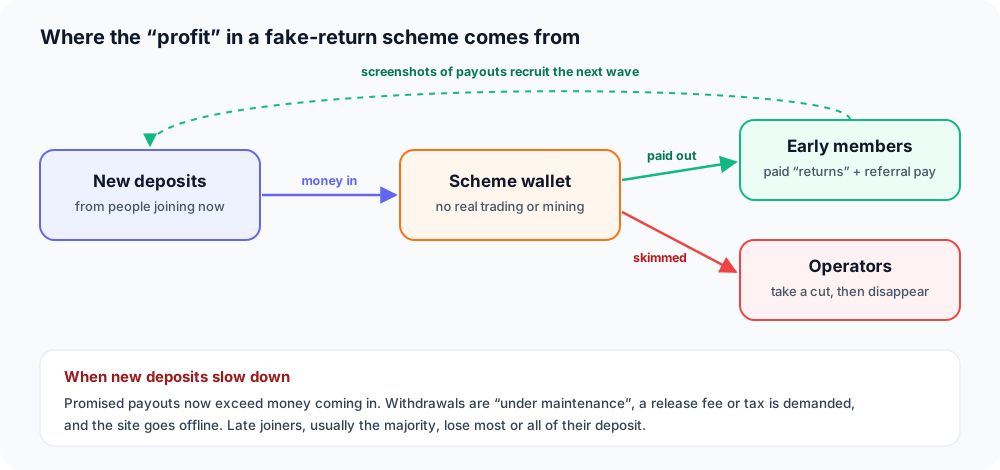
The arithmetic is unforgiving. If a scheme promises 15% every three weeks, it must find 15% of every deposit, plus referral commission, plus the operators’ cut, every three weeks. When the flow of new deposits slows, the wallet runs dry. That is when withdrawals go “under maintenance”, a “tax” or “release fee” is demanded before you can take money out, or your account manager asks you to upgrade to a bigger plan. Paying that fee almost never releases the money.
The twelve warning signs, explained
- Fixed or guaranteed returns. Market returns go up and down. A daily percentage that never varies is a payout schedule, not trading.
- Daily or weekly profit, whatever the market does. Real trading accounts show losing days.
- Tiered plans. Paying a higher percentage for a bigger deposit rewards the operator, not good trading.
- Referral commission on deposits. A legitimate broker may pay a fixed sign-up bonus; a percentage of a friend’s deposit is a recruitment reward.
- Crypto-only or personal-account deposits. Regulated brokers take money into segregated client accounts in their own name.
- A regulator that does not list the firm. “Regulated by the FCA” means nothing unless the firm, its website and its phone number appear on the FCA register.
- Company number, padlock or “certificate” as proof. Registering a company or buying an SSL certificate is cheap and says nothing about permission to manage money.
- Contact via social media. Many cases start with a stranger, a dating match or a group admin who “mentors” you.
- Fees to withdraw. A demand for tax, an upgrade or a release fee before you can withdraw is the clearest sign of all.
- Urgency. Countdowns, limited slots and expiring bonuses are designed to stop you checking.
- No clear source of profit. “Arbitrage”, “mining pool” or “AI bot” with no audited accounts is not an explanation.
- Look-alike testimonials. First names only, balance screenshots and identical wording are easy to fake.
Check the official register before you send money
Search the register yourself rather than following a link the firm gives you, and compare the website address and phone number with the ones on the register. Fraudsters often copy the name of a real authorised firm.
| Where you live | Check the firm | Report a scam |
|---|---|---|
| India | SEBI’s list of registered intermediaries (brokers, investment advisers, research analysts) on sebi.gov.in; RBI’s Alert List of unauthorised forex trading platforms on rbi.org.in | cybercrime.gov.in or helpline 1930; SEBI SCORES for complaints against registered entities |
| United Kingdom | FCA Financial Services Register and the FCA Warning List | Report Fraud (replaced Action Fraud in December 2025), 0300 123 2040 |
| United States | FINRA BrokerCheck for brokers and advisers; NFA BASIC for futures and forex firms | FBI IC3 and reportfraud.ftc.gov |
| Anywhere | IOSCO I-SCAN, which collects warnings from securities regulators worldwide | Your national police or financial regulator |
RBI says plainly that its Alert List is not exhaustive: a platform that is missing from it should not be assumed to be authorised. The same is true of every warning list. The test is whether the firm appears on the register of firms that are allowed, for the activity it is offering you.
Signal sellers and “profit bots” are a different case
Not every site with “trade” and “profit” in its name is a deposit scheme. Some sell a chart indicator or a signal subscription for a one-off fee. Those do not take custody of your money, so the risk is different: you might overpay for something that does not work. Treat any claim of accuracy the same way. Ask for a full, unedited trade history with losing trades included, test it on paper with our backtester or chart replay, and run the costs through the true cost simulator. A strategy with a 55% win rate can still lose money once spreads, commission and slippage are counted.
If you have already paid
- Stop sending money, including any fee to “unlock” a withdrawal.
- Save evidence: website address, chats, wallet addresses, transaction IDs, bank or UPI references and screenshots of your balance.
- Call your bank or card issuer straight away. A fast report gives the best chance of stopping a transfer.
- Report to the national service in the table above. In India, call 1930 or file at cybercrime.gov.in.
- Be wary of “recovery agents” who contact you offering to get the money back for a fee. Recovery scams target people who have already lost money.
What this tool cannot tell you
The checker measures how far a promise is from what markets pay and counts the warning signs you report. It does not know whether a specific website is licensed, and a low score does not mean a firm is safe. A real, regulated product can also lose money. TradeProfy does not review or rate individual schemes and does not offer investment advice.
Questions people ask
Is a 2% monthly return realistic?
As a promised, fixed return, no. Two per cent a month is about 27% a year reinvested. Some traders have good months, but no regulated product guarantees that every month, and regulators treat a guaranteed high return as a warning sign in its own right.
The site paid my first withdrawal. Does that prove it is real?
No. Paying small early withdrawals is how these schemes build trust. Many victims report that the first one or two withdrawals worked and the large one did not.
It shows a UK company registration number. Is it regulated?
Being on Companies House only means a company was registered, which anyone can do for a small fee. To deal in investments in the UK a firm must be authorised by the FCA and appear on the FCA register.
Why does the calculator show the reinvested figure at all?
Because these sites push you to reinvest. Seeing that a modest-sounding daily rate implies thousands of per cent a year makes the impossibility obvious.
Can I share my result?
Yes. Use “Copy share link”: the inputs are stored in the link itself, so the person you send it to sees the same numbers. Nothing is saved on our side.
Sources
- Reserve Bank of India press releases on the Alert List of unauthorised forex trading platforms (first issued September 2022, updated since).
- SEBI investor guidance on checking the registration status of market intermediaries.
- City of London Police: Report Fraud replaced Action Fraud on 4 December 2025.
- FCA ScamSmart, FINRA BrokerCheck, NFA BASIC and IOSCO I-SCAN public registers and warning lists.
Thinking of trading for income instead? See what the research says in how much day traders really make.

Written and maintained by Mantu Kumar
Mantu builds the TradeProfy calculators and checks every formula with worked examples. Each page lists its assumptions. TradeProfy explains costs and maths but never tells you what to buy or sell.