IFVG meaning: the inversion fair value gap explained
IFVG stands for inversion fair value gap, an ICT trading term for a price gap that failed and flipped from support to resistance or the reverse. Here is the plain definition, a diagram, a worked example with numbers and an honest look at whether it works.

Key takeaways
- IFVG stands for inversion (or inverse) fair value gap, a term from ICT and “smart money concepts” trading.
- A fair value gap is a three-candle price gap. It becomes an IFVG when price closes through it instead of bouncing from it.
- After that, the zone is expected to act in the opposite way: old support becomes resistance, and old resistance becomes support.
- It is a discretionary chart idea, not a proven edge. Test it with costs before risking money.
IFVG meaning in one paragraph
An IFVG is a fair value gap that failed. Traders who use ICT (Inner Circle Trader) concepts expect price to react at a fair value gap: to bounce up from a bullish gap or turn down from a bearish one. When price instead closes right through the gap, the gap is said to be “inverted”. The same price zone is kept on the chart, but with the opposite expectation. A broken bearish gap becomes a zone where buyers may defend (a bullish IFVG), and a broken bullish gap becomes a zone where sellers may defend (a bearish IFVG). It is the same logic as the older rule that broken resistance becomes support.
First, what a fair value gap is
A fair value gap (FVG) is a three-candle pattern left by a fast move. Look at three candles in a row:
- Bullish FVG: the low of candle 3 is above the high of candle 1. The space between those two prices, which only the large middle candle traded through, is the gap.
- Bearish FVG: the high of candle 3 is below the low of candle 1. The space between is the gap.
The idea is that price moved so quickly that few trades happened inside that range, so the market may come back to “fill” it. Traders treat an unfilled bullish gap as possible support and an unfilled bearish gap as possible resistance.
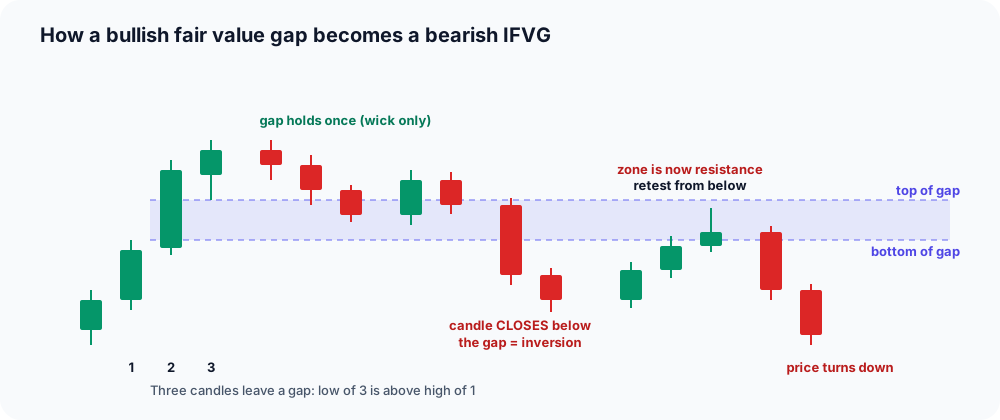
How a gap becomes an IFVG, step by step
- A fair value gap forms. Mark the top and bottom of the gap.
- Price returns to the gap. If a wick dips in and price closes back out, the gap has held; nothing has inverted.
- A candle closes beyond the far side. For a bullish gap, that is a close below the bottom of the gap. For a bearish gap, a close above its top. Most traders require a candle close, not just a wick, to call it an inversion.
- The zone flips. The marked range is now an IFVG with the opposite bias.
- The retest. Traders watch for price to come back to the zone from the new side and reject it.
| Original gap | What breaks it | Becomes | Expected behaviour on retest |
|---|---|---|---|
| Bearish FVG (resistance) | A candle closes above the top of the gap | Bullish IFVG | Zone acts as support; traders look for longs |
| Bullish FVG (support) | A candle closes below the bottom of the gap | Bearish IFVG | Zone acts as resistance; traders look for shorts |
A worked example with numbers
On a 15-minute chart a stock falls quickly and leaves a bearish fair value gap between 498 (the high of candle 3) and 502 (the low of candle 1). Price later rallies and a candle closes at 504, above the top of the gap. The 498–502 zone is now a bullish IFVG. Price pulls back to 501 and starts to turn up.
- Entry: 501, inside the zone.
- Stop: 497, just under the bottom of the zone, so the risk is 4 points.
- Target: 509, the previous swing high, a reward of 8 points.
- Reward-to-risk: 8 ÷ 4 = 2 to 1.
With a risk limit of ₹2,000 on the trade, the position is 2,000 ÷ 4 = 500 shares. If the stop is hit you lose ₹2,000 plus charges; at the target you make ₹4,000 minus charges. Check both with the risk-reward calculator and the position size calculator. A 2-to-1 trade needs to win more than one time in three after costs to be worth taking.
Terms that usually appear with IFVG
- Displacement: the fast, large-bodied move that creates a gap.
- Liquidity sweep: a brief push beyond an obvious high or low that triggers stops before reversing. Many IFVG setups require a sweep first.
- Consequent encroachment: the midpoint (50%) of a gap, used by some traders as the entry or as the level that decides whether the gap has held.
- Order block and breaker block: the last opposing candle before a strong move, and an order block that failed and flipped. A breaker is to an order block what an IFVG is to a fair value gap.
- Balanced price range: an area where a bullish and a bearish gap overlap.
Does it work? An honest view
There is no independent, peer-reviewed evidence that fair value gaps or their inversions predict price better than chance. The concepts come from trading educators, definitions vary between teachers (wick or close, which timeframe, how large a gap counts), and charts shown in lessons are chosen after the fact. That does not make the idea useless: it is a structured way to describe support and resistance flipping, which traders have used for a century. It does mean you should treat it as a hypothesis.
Write your rules down precisely, then test them on at least 100 past cases including the ones that failed, with spread and commission included. The backtesting guide explains how, and candle replay on our charts lets you step through history without seeing the future. Remember what the data says about short-term trading generally: most day traders lose money.
Common mistakes
- Calling a gap inverted after a wick pierces it, before any candle has closed beyond it.
- Marking every tiny gap on a one-minute chart. Small gaps on low timeframes are mostly noise.
- Trading the retest against the higher-timeframe trend.
- Putting the stop inside the zone, where normal movement will hit it.
- Sizing by conviction rather than by the distance to the stop.
Related guides
- Support and resistance, the idea IFVGs build on.
- Candlestick patterns and how to read a chart.
- Pivot point calculator for objective levels to compare against.
Frequently asked questions
What does IFVG stand for in trading?
Inversion fair value gap, also written inverse fair value gap. It is a fair value gap that price has closed through, so the zone is expected to act in the opposite direction.
What is the difference between an FVG and an IFVG?
An FVG is a three-candle gap expected to hold as support or resistance. An IFVG is the same zone after price has closed beyond it, with the expectation reversed.
Does a wick through the gap create an IFVG?
Most traders require a candle close beyond the far side of the gap. Some educators accept a wick, so decide on one rule and test it.
What timeframe is best for IFVGs?
There is no proven best timeframe. Gaps on 15-minute and higher charts are less noisy than those on one-minute charts.
Is IFVG a reliable strategy?
There is no independent evidence that it outperforms chance. Treat it as a hypothesis and backtest your exact rules with costs.

Written and maintained by Mantu Kumar
Mantu builds the TradeProfy calculators and checks every formula with worked examples. Each page lists its data sources and assumptions. TradeProfy explains costs and maths but never tells you what to buy or sell.